Full Production Workflow
1. Raw Material – S20C Seamless Steel Tube
Production begins with S20C carbon steel seamless tubes, selected for their uniform microstructure, good machinability, and weldability. Material certifications are verified upon receipt to ensure compliance with ordered specifications.
2. Quenching & Heat Treatment
The tubes undergo controlled quenching to enhance surface hardness and core toughness. This thermal treatment improves the substrate's resistance to deformation under load and prepares the material for subsequent precision machining. Tempering follows to relieve internal stresses and stabilize dimensional properties.
3. First-Stage Dynamic Balancing
Rough-machined rollers are dynamically balanced to identify and correct major mass eccentricities. This preliminary balancing removes heavy spots before precision operations, reducing the amount of correction needed later and preventing unbalanced rotation from affecting machining accuracy.
4. Thermal Bonding & Straightening
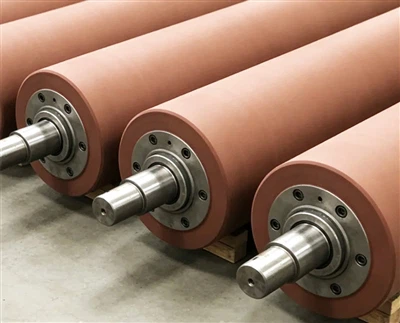
For applications requiring rubber covering or special composite layers, thermal bonding is performed to achieve full adhesion between the substrate and covering material. Simultaneously, straightening is applied to correct any axial deviation, ensuring the roller body remains within specified run-out limits before entering CNC processing.
5. CNC Turning
The workpiece is mounted on CNC lathes for precision turning of outer diameters, end faces, and journal bearing seats. At this stage, dimensional tolerances are brought close to final requirements, leaving only a controlled allowance for subsequent grinding. Concentricity between the barrel and journal axes is established and verified.
6. Grinding & Polishing
Cylindrical grinding refines the turned surface to achieve:
Tight diameter tolerances (IT6 or finer)
Surface roughness below Ra 0.4 µm prior to plating
Roundness and cylindricity within strict limits
Polishing follows to produce a smooth, defect-free base surface, essential for uniform chrome deposition and final release properties.
7. Second-Stage Dynamic Balancing
After grinding, each roller undergoes final dynamic balancing on precision hard-bearing machines. Correction is made in two planes to achieve G 6.3 balance quality or better per ISO 1940. This stage ensures vibration-free rotation at operating speeds, protecting both the roller itself and adjacent machine components.
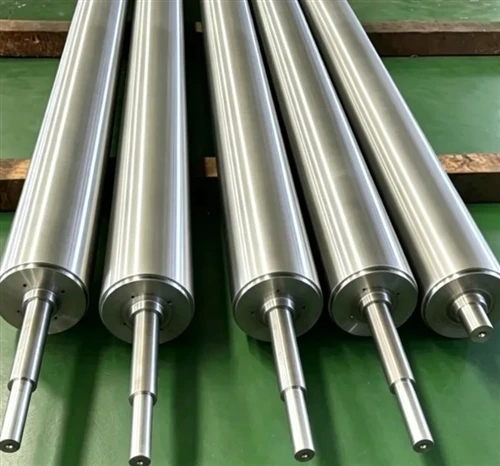
8. Hard Chrome Plating
Electrolytic hard chrome plating is applied to the ground barrel surface. The process is carefully controlled for bath temperature, current density, and plating duration to deposit a uniform layer typically between 0.02 and 0.10 mm. Key attributes of the chrome surface include:
Micro-hardness: 850–1,000 HV
Low coefficient of friction for reduced web drag and scratching
Corrosion resistance against moisture, solvents, and process chemicals
Post-plating hydrogen embrittlement relief is applied where required, followed by finish grinding to restore dimensional accuracy and remove plating nodules.
9. CNC Keyway Milling
End journals and shaft extensions are machined to receive drive keys, sprockets, or timing pulleys. Keyways, slots, and mounting holes are milled on CNC machining centers to customer drawing specifications, ensuring precise fit with power transmission components.
10. Rigid Quality Inspection
Every completed roller undergoes a final inspection regimen that includes:
Dimensional checks on all critical diameters, lengths, and fits
Run-out and concentricity testing with TIR (total indicator run-out) recorded
Surface roughness measurement to confirm final finish
Chrome-layer thickness verification at multiple points along the barrel
Visual examination for surface defects, porosity, or discoloration
All test results are documented against individual serial numbers and retained for traceability.
11. Packing & Shipment
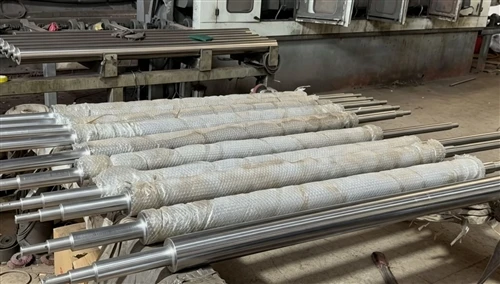
Finished rollers are packed with anti-rust treatment and protective cushioning, secured in wooden crates or steel frames suitable for sea freight. Markings and shipping documents are prepared per customer instructions.
Product Range
Jinhecheng supplies custom-engineered rollers across three primary categories:
Hard-chrome rollers – S20C, 42CrMo, or equivalent substrates with hard chrome finish
304 / 316 stainless-steel rollers – for food-contact, wash-down, or highly corrosive environments
Rubber-covered rollers – with various elastomer compounds for traction, nip, or anti-slip requirements
OEM projects are welcome, with production based on customer drawings, material specifications, and performance targets.
Quality Standards
CE and TÜV Rheinland certifications reflect Jinhecheng's commitment to international quality and safety standards. These accreditations are maintained through documented procedures, calibrated equipment, and continuous process monitoring.
Customization & Inquiries
Customers with specific application requirements – including web width, line speed, tension, chemical exposure, or special coatings – are invited to submit their technical specifications. Engineering review and formal quotations are provided on a project-by-project basis.
Qingdao Jinhecheng Machinery Co., Ltd.